Monday, May 11, 2015

RE-READING MANFREDO TAFURI: ARCHITECTURE AND UTOPIA


READING “ARCHITECTURE AND UTOPIA”
MANFREDO TAFURI

VIII: Preface
The relationship between the historical avant-garde movements and the metropolis, the relationships between intellectual work and capitalist development, research on sociology and planning practices, on social-democrat  administration of the city , on architecture of America cities and on building cycle, have been the object of collaborative program to have arrived at any firm and dogmatic conclusions.

IX: Preface
What is of interest here is the precise identification of those tasks which capitalist development has taken away for architecture.
To the deceptive attempts to give architecture an ideological dress

X: Preface
Instrument of knowledge might be immediately useful to the political struggle.
2: Reason’s Adventure
The bourgeois intellectual’s obligation to exist can be seen in the imperativeness his functions assumes as a social mission.

10: Reason’s Adventure
Not having at its disposal a mature substratum of production techniques adequate to the new conditions of bourgeois ideology and economic liberalism, architecture was obliged to restrict its self –criticism to two areas of ANTI-EUROPEAN SIGNIFICANCE & FORMAL ROLE

41: Form as Regressive Utopia
City as an autonomous field of architectural intervention.
Enlightenment architecture from the very beginning postulated one of the concepts fundamental to the development of contemporary art: the disarticulation of form and the anti-organic quality of structure. Nor is it without significance that the institutions of these new formal qualities was from the first related to the problem of city, which was about to become the institutional locus of modern bourgeois society.

The solicitations of theorists for a revision of formal principles did not however, lead to areal revolution of the meaning but, rather, to an acute crisis of value.

158: Architecture and its Double: Semiology and Formalism.
The attempt to revitalize architecture by means of an exploration of its internal structures comes about just at the moment when avant-garde studies in the linguistic field are abandoning “ambiguous” communications and taking their place in the heart of the productive universe through the creation of artificial programming of languages.

Architectural self-criticism does not go to the root of the matter and has need to hide behind new ideological schemes borrowed from the semiological approach.

An architecture that has accepted the reduction of its own elements to pure signs, and the construction of its own structure as an ensemble of tautological relationships that refer to themselves in a maximum of “negative entropy”

182: Problems in the Form of a Conclusion
Reflection on architecture, inasmuch as it is a criticism of the concrete “realized” ideology of architecture itself, cannot but go beyond this and arrive at a specifically political dimensions.

abstract from book" Architecture and Utopia", Manfredo Tafuri

Thursday, May 7, 2015

KRVIA MASTER'S THESIS - 2015


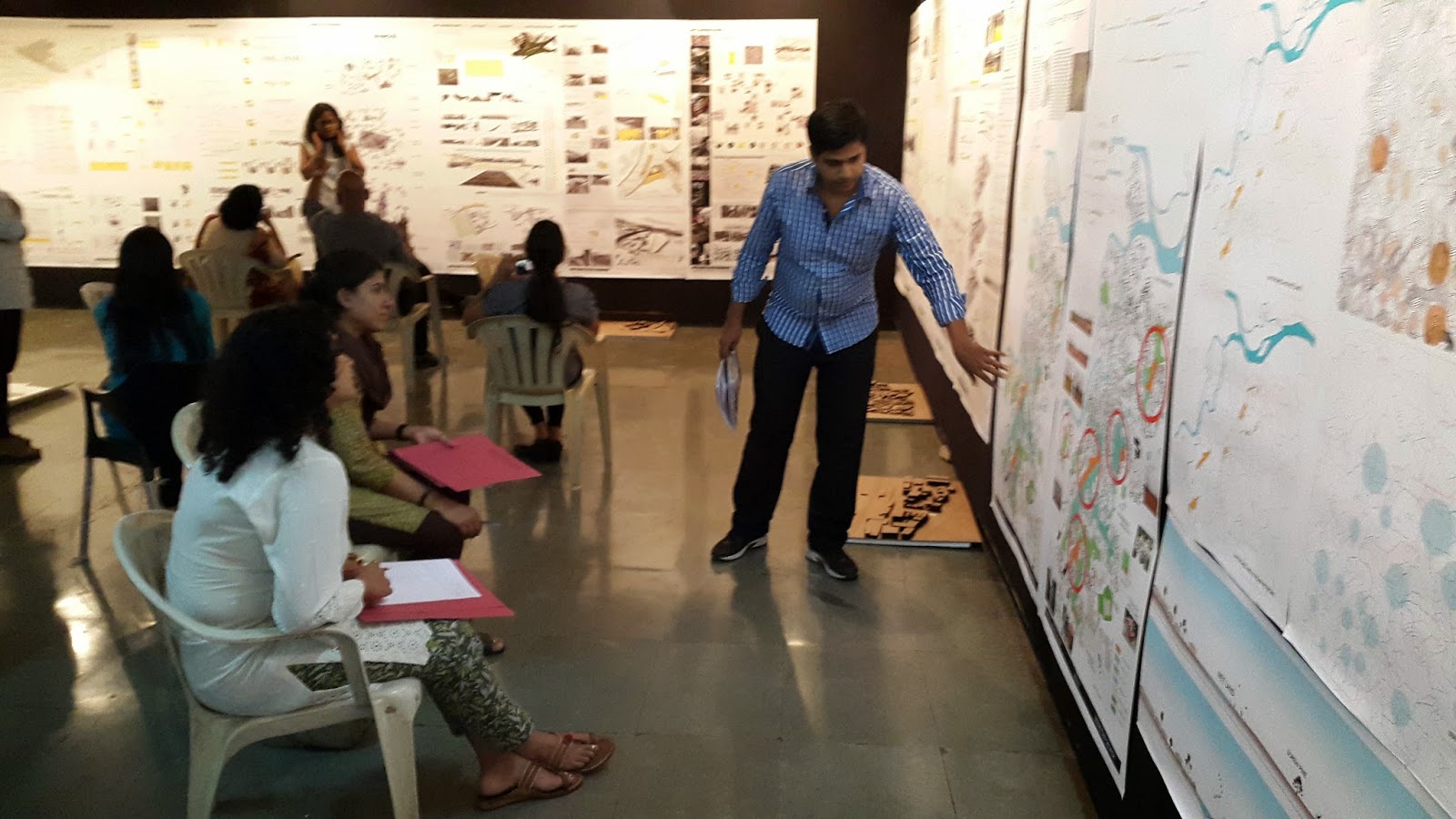
The graduating seventh batch thesis defense oscillated through various thoughts on urbanism. The range and responses are becoming wider and far open ended than predecessor. The idea of conservation is challenged with its limited framework and attempting it to be far more democratic in value appreciation. The queries were raised if conservation value system needs to acknowledge the static and dynamics of social imperatives. The conflict of old and new cities are inherent in Indian context and perhaps needs alternate framework and imaginations and such efforts and ideas are visibly percolating through the second tier city representatives. In conjunction with old and new urbanism the core issues of livelihood and heritage/ tradition remains central in recent research projects. Perhaps time will tell the depth of such investigation and its impact.

The ecology of waste and ecology of environmental systems are another set of research that has emerged over the period of five years and attempting to address the balance of preservation with development. It attempts to break the attitude towards urbanism that is constantly with the mindset of development, ignoring the valuable systems.

The notion of public and private or densities and amenities are an attempt to discuss the idea of “right to the cities”. The research is configured around the physical attributes of urban form, users, ownerships along with time and natural surveillance to such amenities. The research seems to reconfigure the incidental/ evolved urbanism with projected urbanism. These are apparetn issues/reality with most of the historic cities across the nation.

The spatial configuration, sense of place or identity is attempting to overcome the system analysis of urbanism by regulated bodies with spatial analysis. The research perhaps needs to address the issues of interpersonal competencies along with various social transactions. The distinction between public realm (spatial condition for transaction or interface) and public space (physical condition for pause) is still blurred but closely scanning the tactical responses on time scale.


The research needs to get further sharpen in key areas of Inquiry, Methodology & Representation. If distinction among data, information & knowledge is articulated somewhere in the process than impact of research and demonstration can have embeddedness with wider reaching consequences.  


Tuesday, April 7, 2015

CONSERVATIVE CONSERVATION

A lot has been said on conservation especially world has turned this discipline into a fashionable and niche-able commodity of past. This is perhaps true in urban forms of traditional Indian Cities. The traditional urban architecture and its conservation broadly divided into three broad categories: Ideology of Conservation,  Practice of Conservation and Technology that need to be employed. 

Architecture and Urban form that embodies the regional values,  needs to be understood and its implication of them being conserved on larger interest of the cities. Such artifacts need to be conserved on its formal properties along with long term conservation plan. This two ideological positions are often at conflict with each other but one thing is clear that conservation is not an attempt to conserve the past but to preserve the present. It is moral obligation of present generation to pass such artifacts to next generation in the state that they have received from previous generation.

The domain of conservation is slowly slipping away from archaeological sphere but in the process the scope of conservation has widen beyond its conservative approach. It perhaps does have its own virtues as conservation needs to be integrated largely with the development but complexity that arises from such wider approach is the paradoxical extremities of development versus conservation. 

The visit to Ajanta caves happened after 20 years. The formal change in the large landscape as a part of conservation plan was apparent. It seems to have larger heritage  management plan being implemented along with restoration, traffic management, environmental concern to the caves and its sculptures & paintings. The caves approach is made easier with ramps and satires along with signage. However the Ajanta caves project can not be the pilot project for conservation/ restoration our pre-industrial cities and their historic core. 


Friday, March 27, 2015

KRVIA MASTERS: STUDIO II: URBAN DESIGN/ URBAN CONSERVATION.

STUDIO II

The pre-industrial cities are rapidly transforming itself into a large urban agglomeration. This cities are often developed without direction or development guidelines. This kind of haphazard transformation is rapidly seen in most of cities across India. These cities are characteristically evolved with humane scale, contextualized typologies, walk-abilities, compactness and appropriate living and working relationships. These cities also offers lesson to basic urban design leanings in terms of formal and informal togetherness, bazaar conditions, community living, cultural conditions & social homogeneity. These conditions are very important to urban learning. 

The studio aims to decode these complex web of interrelationships and allow strategic interventions for transformation through housing in Jodhpur. The four areas studied through field trips, namely: Infrastructure, Tourism, Housing, Community. These parameter may not be mutually exclusive but complex enough to study such conditions. 

The intent of this studio was to derive an operative methods for improving the housing scenario in the inner city area of Jodhpur, through the area of study.  It was explicitly revealing that typological system that exist in such cities are product of far more complex systems and conditions, The methods perhaps are limited for the academics exploration but systems need to explore beyond the conventional norms.


Saturday, January 31, 2015

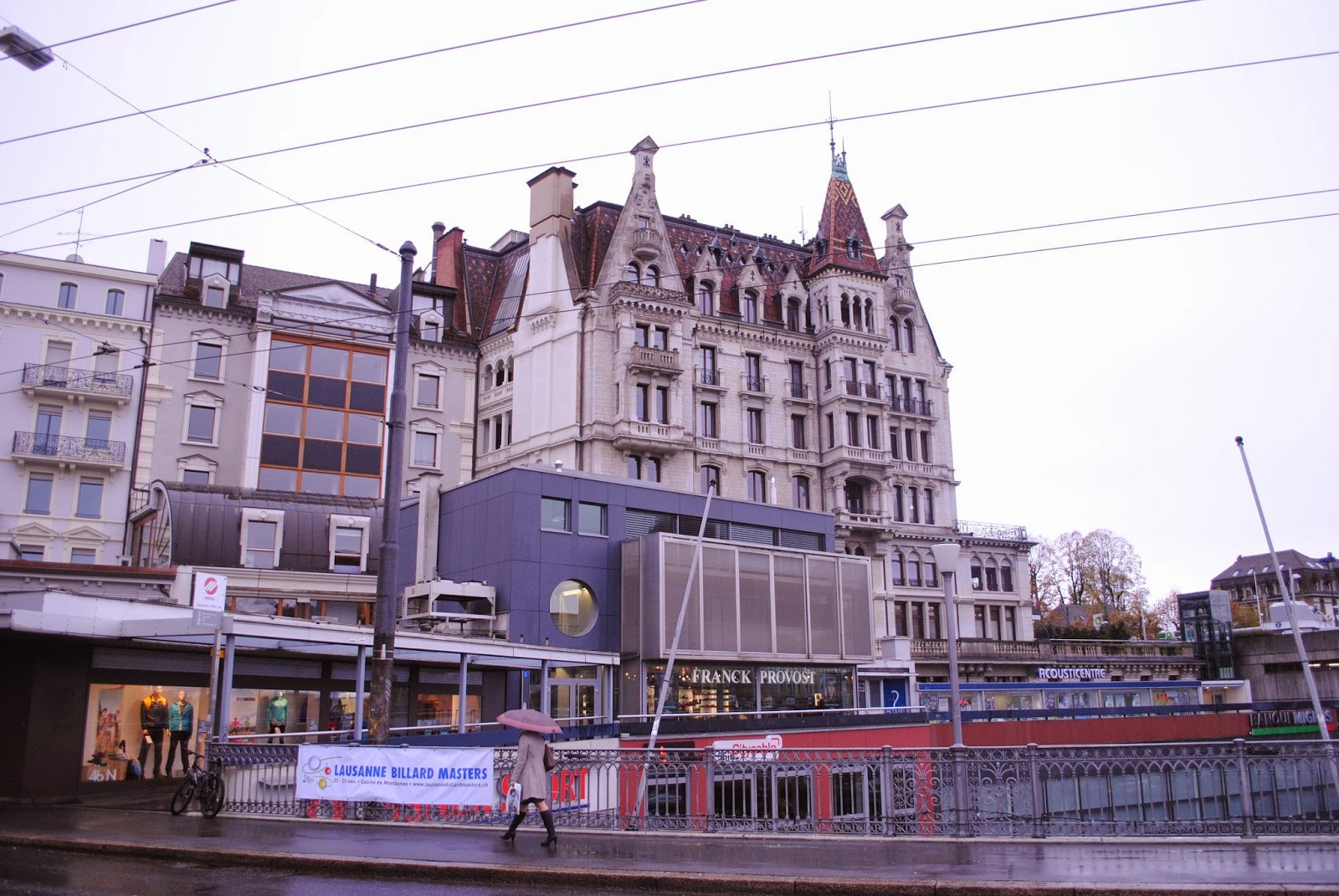
CLUSTER MEETING AT SWITZERLAND (BASEL + LAUSANNE)

THE LABORATORY APPROACH TO BUILT ENVIRONMENT EDUCATION.
(ABSTRACT FROM SYMPOSIUM MEETING HELD AT TU-BERLIN)

The project URBAN LAB+ is an initiation to set the interactive platform for various educational institutes who are involved in higher education in urban studies. The URBAN LAB+ is involved eight partners with TU BERLIN (Technische Universitat, Berlin, Germany) as host and coordinator for the entire project.

The Larger interest of URBAN LAB+ is to promote higher education, improve services of international students & strengthening relation among the institutes across the world. The partners of the URBAN LAB+ are as follows:

-       Technische Universitat, Berlin, Germany (TU)
-       University College, London, UK
-       Ecole Ploytechnique Federale De Lausanne, Switzerland.
-       Universita Della Calabria, Italy
-       Pontificia Universidad Catolica De Chile.
-       University of The Witwatersrand, South Arfrica
-       Kamla Raheja Vidyanidhi Institute for Architecture & Env. Studies, Mumbai, India
-       The Chinese University of Honkong.
-        
URBAN INCLUSION

It began with emphasize on process of urban dynamics of our cities that needs clear planning strategies for future projection that may have impact of our daily life. It needs to be articulated through dialogue that needs to be synchronized within academics setups,  especially among universities across the section for global learning. The URBAN LAB+ invited the international partners and elaborated the subject of international urban issues which requires collaborative research,  Intellectual and disciplinary resources & how URBAN LAB+ can facilitate the entire process with in collaboration with EU.


Ethical and Moral Construct of Modern